

Leadership style should depend on seniority of your team members. Unfortunately, seniority might be on different levels on different tasks. You organisation may do a pivot, and now you have to do things you’ve never done before. You have senior people on board, but they have also learn new things… Should you trust their seniority, or treat them as newcomers? Both ways will cause troubles.
Situational leadership approach should come with help. Developed by Paul Hersey in 1969, this model provides a repeatable process for matching leadership behaviours to the performance needs of those, being influenced.
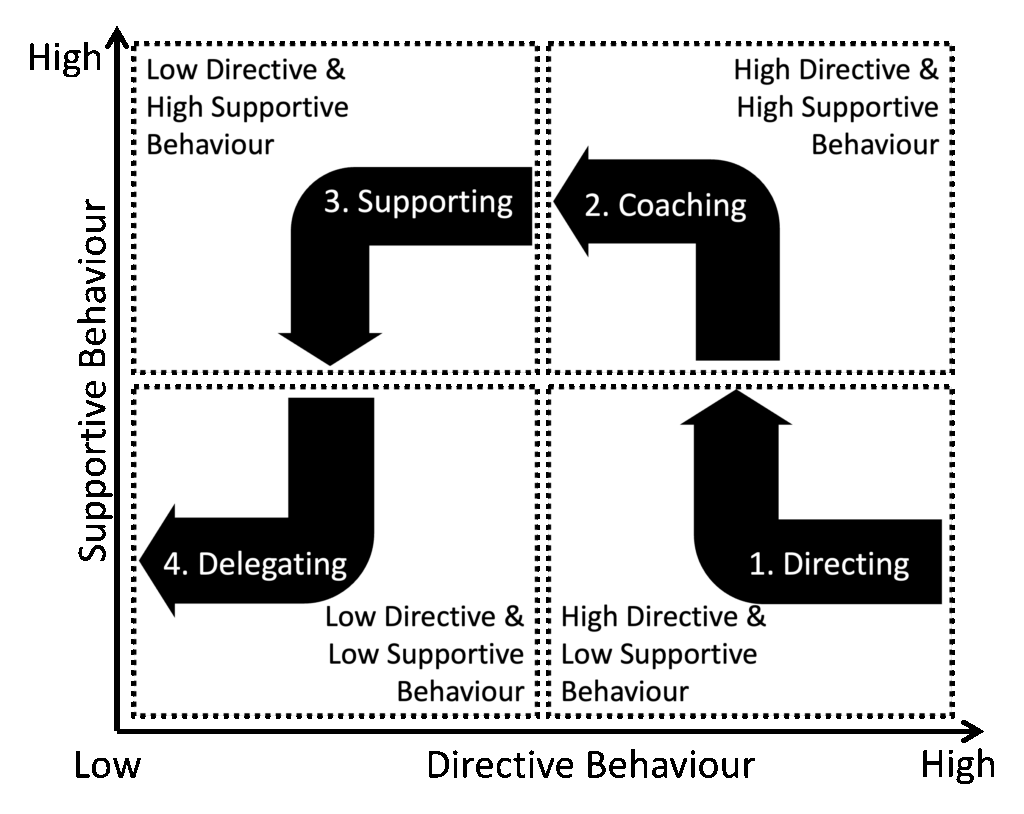
Idea is to go with specific approach based on individual’s seniority level on specific task.
Most often I have it in my marketing, I work with talented person, who’s doing great on her job. But from time to time we have to explore new field. Usually I explain that we’ll do new things, so we some changes in our interaction will appear:
- we will interact more often (even few times a day);
- I explain what should be done and how;
- I want to see every stage of work done;
- there are no stupid question;
- if you have any concerns – contact me immediately.
This would be called “Directing” leadership style. Never less I work with a senior person, but when we come into new fields, we come to this approach. The only difference, we stay in different stages shorter with rising of seniority level. Directing style helps to avoid mistakes and misunderstandings, we discuss tasks very often and there is no room for wasting time, looking for different solutions. There is only one reasonable – mine. When we start receiving predictable results, we may go into next level. Coming to “Coaching” leadership style, which means:
- we will interact often, but less than earlier (up to twice a day);
- I explain what result I expect, keeping in mind what and how;
- I want to see every stage of work done;
- there are no stupid question;
- if you have any concerns – let’s discuss them during next meeting.
This stage gives some room for creativity. Level of control is still very high. After this stage I make a decision, if this person is the right one for this task or not. If yes, – we go with “Supporting” leadership. If no – dependant on situation you may stay on this level (it will burn out your employee in some moment), you may move task to other person or outsource it. Earlier you get it out of that specific person – better.
Going next to Supporting scenario:
- we will interact less often (every few days);
- I explain why we need result of this process in our company;
- I want to see and discuss every final stage;
- there are no stupid question;
- if you have any concerns – try to solve, check if there any external consultancy possible.
This stage usually takes some time, but at some level there are no questions, creativity goes in different directions, lessons learned and trajectory adjusted. We’re redy to “Delegating” stage:
- we move to casual 1-on-1’s (every few weeks);
- we talk about life and sometimes touch processes;
- I want to get information about anomalies happening;
- there are no stupid question;
- if you have any concerns – come with proposed solutions.
Of course, the best situation is to have all tasks and processes in your company on Delegated level. It gives you time to work on company strategy. At the same time Delegating helps team to feel their value and decrease burn-out chances.